I’ve been reading a lot of vintage cookbooks lately, and community cookbooks in particular have fascinated me with their old-fashioned measurement terms.
You know the ones I mean—those recipes passed down from grandparents and great aunts that call for a pinch, dash, or smidgen.
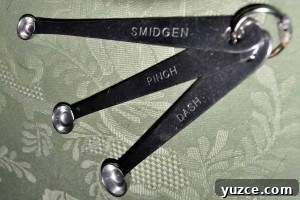
Translating those informal amounts into modern measurements can be tricky. Recently I found a simple solution: a set of labeled measuring spoons that removes all the guesswork.
They are marked “Pinch,” “Dash,” and “Smidgen,” which makes it easy to match the old terminology to consistent volumes.
After a bit of research I confirmed the commonly accepted modern equivalents for these tiny measures:
SMIDGEN – A smidgen is typically considered 1/2 of a pinch, or about 1/32 teaspoon. Two smidgens equal one pinch.
PINCH – A pinch is commonly 1/16 teaspoon, or half a dash. Two pinches equal one dash. Historically, a pinch was described as “an amount that can be taken between the thumb and forefinger,” without a precise standard, which is why modern labeled spoons are helpful.
DASH – A dash is generally 1/8 teaspoon. Eight dashes equal one teaspoon. The term originally referred to a small, indefinite liquid measure, and over time it has been used for both liquids and dry ingredients.
That is the consensus among most cookery and measurement references. There is some debate in older sources about whether pinch and dash were reversed, but the measuring spoons I found list Dash as the larger of the three.
Of course the real test will be trying one of those vintage recipes and seeing whether the seasoning is right—or whether I’ve added too much salt!
If you’re curious about the cookbook pictured, it’s available for purchase from the retailer listed on the image.