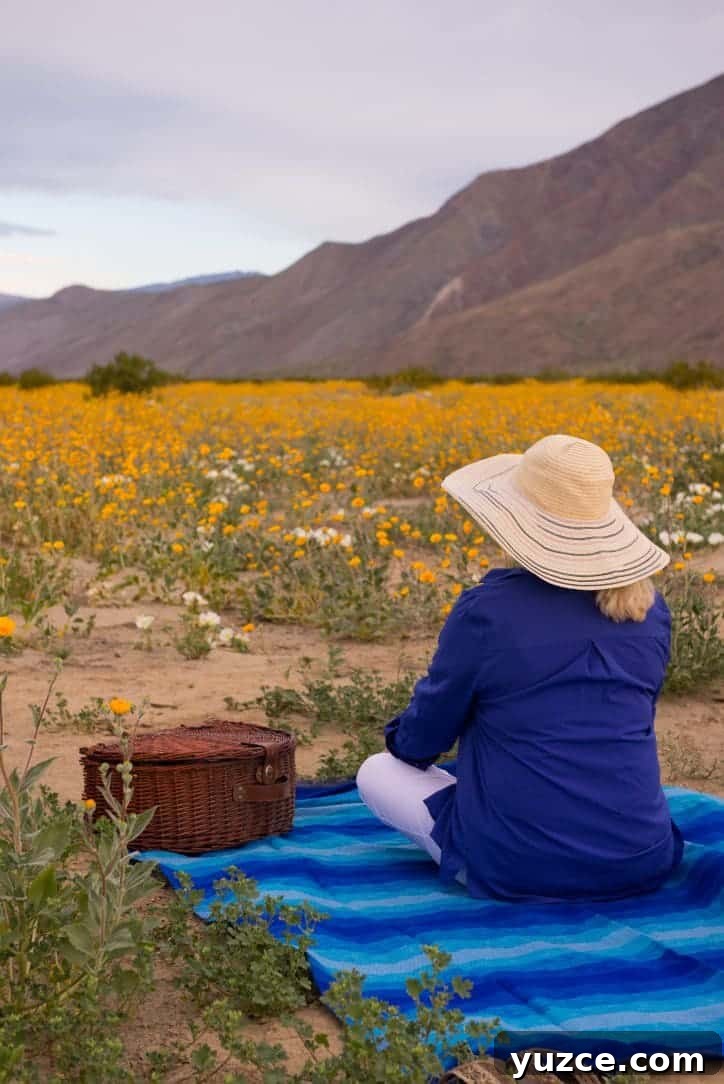
Happy Spring!
For days we’ve been hearing reports of a “super bloom” of wildflowers across the region. After several years of drought, this winter brought much-needed rains to California, and parts of the desert responded in spectacular fashion. Anza-Borrego Desert State Park, a couple of hours east of San Diego, received an exceptional seven inches of rain this season. That abundance turned large swaths of the park into what locals call a super bloom — a rare event that may occur once every 10 to 20 years. My husband and I decided we couldn’t miss it. Spring is our favorite season, after all.
Because super blooms attract so many visitors, campsites and nearby hotel rooms were fully booked. With accommodation scarce, we opted for primitive camping. Anza-Borrego allows dispersed camping: you can set up a tent one car length off the road. So we packed our truck with a tent, sleeping bags and supplies, and headed out. When we arrived, the landscape was breathtaking — like stepping into a fairy tale.
Desert Sand Verbena in all its glory.
An array of color
After checking the main wildflower hotspots near Borrego Springs, we were directed south to Little Blair Valley. There we found a perfect camping spot: an expansive field of green grass dotted with yellow blooms. By morning, a carpet of purple flowers had emerged as well, making the view even more magical.
Our campsite at Little Blair Valley, Anza-Borrego State Park
The purple ones graced us with their presence in the morning
While exploring, we discovered the Ehmuu-Morteros Trail, an area that served as a seasonal home to the Kumeyaay people. “Ehmuu” means “bedrock hole” in their language, and “mortero” is Spanish for “mortar.” Along the trail we found rock formations that functioned as a kind of outdoor kitchen: deep morteros used for cooking and shallow basins for grinding seeds, roots and medicines.
The deep morteros were used to cook stews and mush, heated by dropping in hot stones from the fire. The shallow ones were used to grind food and medicine.
The rocks on the trail show how the Kumeyaay used pounding, grinding, drying and mixing techniques to prepare food gathered from nearby plants. It felt like stepping back in time to imagine daily life there.
One section of the trail called the “Emally Forest” was a natural supermarket for the native inhabitants. Named for the giant agave (emally), this area provided an abundance of edible and useful plants. The Kumeyaay roasted agave in rock-lined pits for up to three days before eating it. Juniper berries, yucca, jojoba, cacti, creosote and ephedra were also gathered for food, medicine, tools and materials for shelter and clothing. The hike offered both historical perspective and the visual delight of wildflowers in bloom along the path.
Here are a few more images from our visit. I hope they inspire you to chase wildflowers yourself. A field of blooms has a way of lifting the spirit and making you feel childlike, wild and free.
A picnic in a sea of flowers
A beautiful bloom on a cactus
Advice from a wildflower:
- Show your true colors.
- Delight in simple pleasures.
- Open up!
- Spread seeds of joy.
- It’s OK to be a late bloomer.
- Be wild and wonderful!
Until next time,
Warmest regards,
Darlene Longacre